

Metro Atlanta Colleges are Top Transfer Destinations
Louis Apraku-Boadi, a senior at the Georgia Institute of Technology, is set to earn his degree in chemical engineering. But he didn’t begin his quest for higher education at the ... read more

By Ken Abramczyk
Patients who suffer from strokes, concussions or Alzheimer’s disease face neurological challenges to regain their quality of life. They turn to doctors and healthcare facilities for help and optimal care. For many patients in the Atlanta area, assists them by treating these neurological conditions and others, including Parkinson’s disease and learning disabilities. The institute, which is housed in nearly 4,000 square feet of space just off campus on Barclay Circle in Marietta, also trains chiropractors for certification and works closely with researchers at Life University.
Dr. Michael Longyear, director of applied clinical neuroscience, says that the institute works holistically—that is, without drugs or surgery—on many neurological medical conditions to restore and optimize brain and neurological function. The institute started in 2012, led by Drs. Ted Carrick and Guy Riekeman, who were followed by Dr. Michael Hall; today, Longyear leads the institute in its research, clinical applications and educational programs.
“We work with everything from neurological developmental disorders like autism, ADHD and learning disabilities all the way up to neural degeneration like Alzheimer’s and Parkinson’s and everything in between,” Longyear says. “We’ve worked with every level of athlete, from children up to professional hockey players and football players with concussions, and the performance enhancement side of things as well, so any that has a neurologic component, we can be a factor in.”
According to Longyear, the institute follows ’s holistic mission, emphasizing nutrition and chiropractic care to improve the body’s vitality and address its “interferences,” which can be described as neurological conditions that hinder the patient. He explains, “What we do is design exercises and programs to remove those interferences in the nervous system to allow the brain to heal properly and become more efficient.”
The work is based on applied clinical neuroscience, which “is the understanding that your brain has plasticity,” Longyear says. “Neuroplasticity is a fancy word to say that your brain has the ability to learn new tricks. We used to think that only children have this ability. When you watch a baby grow, he learns to walk. The baby falls down the first five or six times, but the brain learns and soon he learns to walk upright, and then his gait becomes smooth. That’s neuroplasticity at work. That’s your brain literally learning how to respond to the environment better and differently.”
Longyear says recent science shows that humans maintain that ability even as they age, up until death. He explains, “Your brain has the ability to rewire itself. What applied clinical neuroscience is doing is taking that application into the clinical setting.”
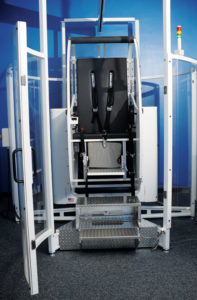 NeuroLIFE Institute’s therapies are designed to activate areas of the brain that appear less efficient than others during an examination. Part of that activation includes the use of a Gyrastim, which resembles a giant chair that might be used in space training at NASA. When treating children, the institute references the exercises as “superhero training” or “space training.” This giant chair spins the occupant forward, backward, right and left. While spinning, the occupant shoots a laser to hit targets. Longyear notes, “ restores smoother movement and improves processing speed, perception and reaction.” The Gyrastim assists concussion rehabilitation, but it is also used for learning disabilities and other conditions.
Longyear explains that the brain’s three jobs are to perceive the environment, process information and formulate a reaction; the Gyrastim and other equipment help patients “rewire” the brain. Photoreceptors in the eyes pick up light, while proprioceptive receptors pick up movement; hair cells in the ear pick up sounds, and other ear cells pick up rotational movement. And through an additional piece of equipment, a vibration plate, the patient works to complete balance exercises to activate an area of the brain responsible for balance and coordination.
Longyear says successful movements improve thought processes. As part of treatment for patients with balance and movement disorders, the institute decided to test them for depression and anxiety. Patients practiced one-legged stands during their treatment; once they were able to do a one-legged stand really well, their depression, anxiety and stress scores declined. Longyear says, “We realized bad movement equals bad brain equals bad thought process. Good movement equals good brain equals good thought process. Much of what we do is movement-based therapies.”
With this in mind, the institute continues to study and research the effects of chiropractic treatments and applied clinical neuroscience on the brain. Recent research includes how applied clinical neuroscience can help patients with medication-resistant depression. “We’re in the early phases, but it is already showing some promising results,” Longyear says.
NeuroLIFE Institute offers professionals a 100-hour certification in applied clinical neuroscience. The program highlights recent applied clinical science research and that treatment’s impact on the brain so that chiropractors can apply it to their own practices. Those interested in the certification program or people seeking assistance with neurological conditions can visit the institute’s website for more information, and patients can obtain referrals to visit the institute from their doctors or chiropractors.
Longyear reveals that the institute continues to incorporate technology and research to advance the institute’s mission and holistic approach. He concludes, “Now with some of the technological advances, some of the advances in research, we’re really starting to understand how profound chiropractic is and what it’s been doing for the brain all this time.