


General Electric chose it for the North American headquarters of its Information Technology unit. Honeywell named it as the headquarters of its Home and Building Technologies business and committed to building a state-of-the-art Software Center. Kaiser Permanente opened an expansive information technology campus in the heart of it. Global consulting titan Accenture selected it as the central location for a network of 10 tech innovation hubs that will be built around the nation. And e-mail marketing juggernaut MailChimp, named 2017 Company of the Year by Inc. Magazine, has called it home for 17 years. For these successful, renowned companies, it only makes sense, as they recognize what so many other firms know as well: Atlanta has become one of the top spots for tech-based business.
So how did it happen? While places like Silicon Valley, San Francisco, New York and Boston have become synonymous with technology, the city of Atlanta traditionally has not been on that acclaimed list—until recently, that is. In fact, in 2017, placing it in the number three position in the country to become a tech mecca. Also in 2017, , and Atlanta landed at number 17. It’s an impressive accomplishment. And while it may seem like it came out of the blue, it’s actually something that’s been developing for quite some time.
“We’ve been a 50-year overnight success story,” says Grant Wainscott, senior director of Technology Ecosystem Expansion for the Metro Atlanta Chamber. “There are many layers involved in making Atlanta the tech mecca it is now. It’s been a long road to get to where we are. It’s taken a long time for Atlanta to position itself as a global leader and to have all of the factors that go into the bouillabaisse of a tech community. We have a lot of people rowing in the same direction right now and a real cohesiveness. It’s been a great lead up to what has happened in the last four or five years.”
Check It Out
According to David Hartnett, chief economic development officer for the Metro Atlanta Chamber, technology has quietly been part of Atlanta’s economic landscape for decades. Of course, it wasn’t the same technology we refer to today. In fact, it was the predecessor to what is currently referred to as FinTech, otherwise known as financial technology.
As financial technology evolved, an entire payment processing industry grew up around the Federal Reserve Bank of Atlanta; today, more than 70 percent of all payments processed in North America—which total more than $5 trillion annually—go through companies that are located in the city.
“The real true grassroots of FinTech started in Atlanta,” Hartnett reveals about the bygone days of the banking industry. “If you wrote a check, it went through the Federal Reserve. That transaction happened here in Atlanta.” When the Federal Reserve Bank of Atlanta became one of the first to automate the process of clearing checks, the quick and efficient system became celebrated within the industry, as well as throughout the country. That success drew businesses that wanted to be located near the Federal Reserve Bank, putting Atlanta on the map and boosting its growing business community. And as financial technology evolved, an entire payment processing industry grew up around the Federal Reserve Bank of Atlanta; today, more than 70 percent of all payments processed in North America—which total more than $5 trillion annually—go through companies that are located in the city. In fact, as the Metro Atlanta Chamber notes, FinTech in Georgia is responsible for more than $30 billion in annual revenue.
 Federal Reserve Bank of Atlanta
Of course, the technological boom didn’t stop there. Over the years, tech has permeated every industry imaginable and made its way into people’s everyday lives. And, unbeknownst to many, Atlanta has actually become the epicenter of so much that is going on in the technology world. “The industrial age is moving to a digital age,” Hartnett states. “And companies have noticed that Atlanta is a thriving area for digital transformation.” What makes the city even more attractive to businesses is that it has found a way to stand out among today’s other leading tech hubs.
Diversification is Key
In Silicon Valley, consumer electronics are king. In Boston, it’s biotech. Raleigh is known for the Research Triangle. In most cases, when a major city is a tech mecca, it has a specific niche in the market. Atlanta bucks that trend.
“The key to our market is that we’re not a one-horse town,” Wainscott reveals. “About three years ago, David Hartnett stood up a new team, and we agreed on a palette of ecosystems that we want to market and support. We look at those main clusters and try to grow those ecosystems globally.”
The key industry segments identified by the Metro Atlanta Chamber include FinTech, Mobility and IoT (Internet of Things), Health Information Technology, Cybersecurity, B2B software, Smart Grid Technology and Film/Digital media/Entertainment Tech. Each of these clusters can be found as an independently thriving sector of Atlanta’s overall tech community. And within each vertical, companies of all sizes are represented, from small startups to midsize firms to large Fortune 500 corporations. The myriad companies have either been founded in or relocated to Atlanta to take advantage of the many benefits the city offers, and their presence has raised the tech community’s profile.
According to the Center of Innovation for Information Technology, more than 14,300 tech companies reside in Georgia. The Metro Atlanta Chamber adds that the city employs nearly 190,000 technology workers across all of the industry segments, and . Site Selection Magazine listed Atlanta as the number four North American metro area for competitiveness in the IT and communications industry. And Sungard Availability Services named Atlanta as the number five city in the country for tech start-ups.
“It feels like once a week there’s an announcement of a new company coming here,” says Andreas Economopoulos, director of recruiting for Professional Insight, a Woodstock-based technology recruiting firm. “There are so many examples of software companies from the west coast relocating to Atlanta. It’s like a switch was flipped over the last 18 months. It feels similar to the late 1990s, but with a caveat. Then, as we all know, companies would scale, grow, scale, grow—and then it all crashed. But now Atlanta is being seen as a new research and development base. So I’m cautiously optimistic. Tech isn’t going anywhere.”
“We’re on fire right now. The digital age in Atlanta is unbelievable,” Hartnett asserts. “Companies see the access to an ecosystem that will support their growth and, ultimately, their sales.”
 Technology Square at the Georgia Institute of Technology
The Attraction to Atlanta
There are actually a number of factors that have drawn tech companies, as well as more traditional organizations that are moving into the tech arena with innovative products and services, to the city of Atlanta. One of the first, according to the Technology Association of Georgia (TAG), is that impressive presence of strong technology clusters. Additionally, companies of all sizes want to have access to a blend of assets that is unique to this flourishing high-tech urban center.
According to the Center of Innovation for Information Technology, more than 14,300 tech companies reside in Georgia. The Metro Atlanta Chamber adds that the city employs nearly 190,000 technology workers across all of the industry segments, and WalletHub notes that it is number three in the nation with the highest STEM (Science, Technology, Engineering and Math) employment growth
The Life Cycle of Innovation
The ability to transform an idea into a viable product or service is at the heart of every company in the tech world. In Atlanta, there are numerous resources available to take firms through that entire life cycle, from concept to development to market. And they are particularly beneficial for tech startups.
“We have incubators and accelerators that will help germinate ideas from an early stage,” Wainscott notes. The Metro Atlanta Chamber points to such facilities as the Advanced Technology Development Center (ATDC) at Georgia Tech, Atlanta Tech Village (also known as Atlanta’s Startup Hub), Flatiron Opportunity Hub, Flashpoint at Georgia Tech and VentureLab, among others. It’s these resources that give startups the support they need to bring their concepts to life. And as those companies grow, moving from startup to midsize firm to major corporation, Atlanta can support that maturation—oftentimes by way of collaboration.
“We have thousands of startups, and larger corporations want to be close to them,” Wainscott explains. “It’s hard for a Fortune 500 company to innovate. They’re publicly traded and can’t pivot on a dime. They need access to disruptive technology. You need that constant creation of new ideas to keep from becoming stale.” By developing corporate innovation centers, those large organizations can partner with smaller companies that are developing the cutting-edge technology of tomorrow. It’s a win-win situation as “the companies can feed off each other,” he says.
Funding and the Cost of Doing Business
As Hartnett notes, the availability of funding is a critical element when it comes to a company’s growth strategy. In Atlanta, access to seed funding, angel funding, venture capital and more is on the rise thanks to the city’s reputation as a burgeoning tech hub. What’s more, the metro Atlanta region is known for its business climate, which includes an overall low cost of doing business—something that’s very attractive to investors. “Venture capitalists want their money to go a longer way. When they save money, they make more money. They don’t want to go to high-cost markets,” Hartnett says.
In addition to generally low business costs, many companies can take advantage of tax incentives offered by the city and the state. This is particularly noticeable with Georgia’s Film, Television and Digital Entertainment Tax Credit, which includes tax credits of up to 30 percent for companies that produce everything from movies and television shows to interactive games and animation. The incentives have created a blossoming industry that has generated a $9.5 billion economic impact for the state, according to Governor Nathan Deal. In fact, Georgia is now the number one filming location in the world.
 Filming The Walking Dead around metro Atlanta
A Talented Workforce
“When it comes to tech talent, there’s a talent war like I’ve not seen before,” says Sandy D. Welfare, executive director of Women in Technology (WIT), an Atlanta-based organization that is dedicated to helping women of all ages find advanced opportunities in the STEAM (Science, Technology, Engineering, Arts and Math) arena. “Small, medium and large companies are looking to find the next generation of superstars and tech leaders.”
With the high concentration of technology companies in Atlanta, potential employees are flocking to the area to access an array of opportunities. “We have a very low unemployment rate across all industries, but we have zero unemployment in technology. We have thousands of jobs that need to be filled,” Hartnett says. As the talent arrives, individuals bring with them outstanding industry experience. Yet, it’s not only the already available workforce that makes a difference to firms seeking employees.
“The pipeline of talent that is coming out of the universities is amazing,” Hartnett continues. Intown and metro area universities like the Georgia Institute of Technology, Emory University, Georgia State University, Morehouse School of Medicine, Kennesaw State University and Gwinnett Technical College are becoming recognized worldwide for their strong technology-based programs. The number of students matriculating through them is increasing, and those graduates are becoming the working professionals who are changing the face of the tech industry. And the talent is so skilled that .
“Everybody is in the talent business now,” Wainscott says. “And companies don’t just need access to talent—they need access to talent that’s priced right. It is a massive draw for this region.” With more than 300,000 students graduating annually from over 70 regional colleges and universities, the talent pool will continue to surge, and Atlanta-based companies will benefit from the influx of potential candidates.
OTP Options
While much is said about Atlanta as an urban tech center, one strength of the area is that technology companies also have embraced the opportunity to move outside of the city limits. Companies in all of the key tech verticals can be found outside the perimeter, or OTP.
For instance, according to Tech Alpharetta, the city of Alpharetta, which is located less than 30 miles north of Atlanta, boasts more than 640 tech companies within a 22-square-mile radius. What’s more, Avalon, the city’s newest mixed-use development, has attracted such significant tenants as the Microsoft Technology Center, and Gwinnett Technical College recently opened a satellite campus across the street from the bustling live-work-play community.
“Alpharetta is bringing in tech companies at quite a clip,” Welfare states. “They’re doing a lot to entice people to locate there, and they’ve also been able to harness the talent there. There are many smaller communities that will enhance their offerings like this. They want to be where the talent is.”
Gwinnett County also has seen a surge in the relocation and opening of tech companies, thanks in part to the existence of such locales as the 500-acre Technology Park in Peachtree Corners, which actually got its start in the 1970s. Now Peachtree Corners is becoming a hot spot for tech innovation; in late 2017, Atlanta Tech Park, a 43,000-square-foot Global Innovation Center, opened its doors to serve companies that have passed the incubator stage and need to move forward to the next phase of growth.
Across town in Marietta, Lockheed Martin joined forces with Georgia Tech to expand the latter’s research enterprise. In 2016, the global aerospace company signed a contract on a real estate deal with the university for four buildings that are now being used for research and education purposes. That deal has led to an additional opportunity, with Georgia Tech now looking to secure approval for a $63 million campus at Lockheed Martin.
“We didn’t develop as a dense urban core like some northeast or west coast cities. We are more spread out,” Wainscott notes. “So we have a lot going on outside of the perimeter, from Fayetteville to Alpharetta to Woodstock. The entire region has embraced .”
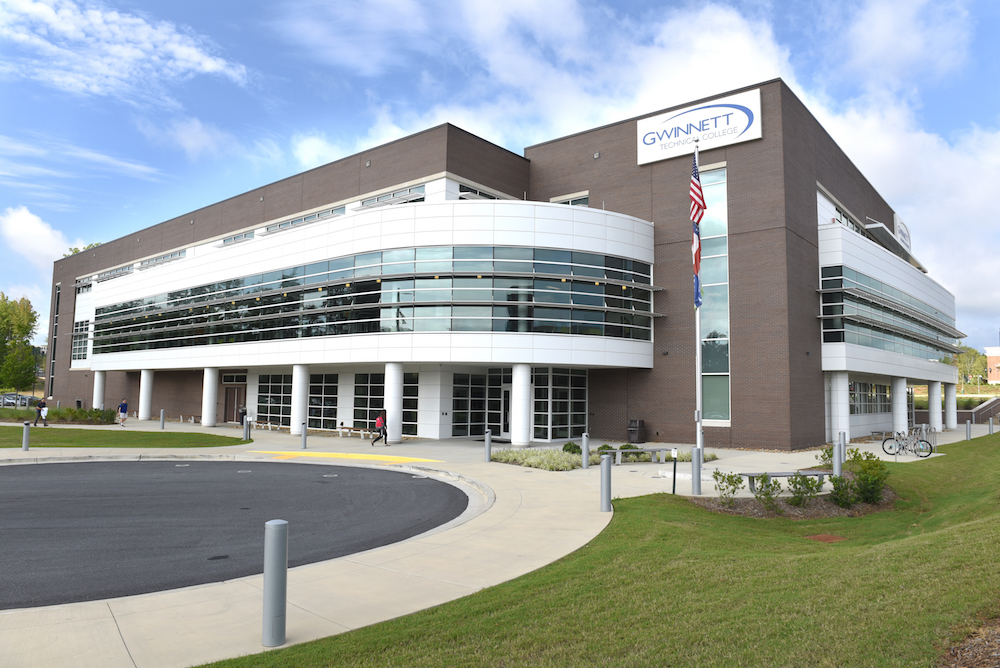 Gwinnett Technical College
Build It and They Will Come
Atlanta’s many benefits do not only apply to the tech companies that decide to call the city home. The metro area is a huge draw for the job candidates who want to be part of the booming industry. And they have the distinctive opportunity to evolve in their careers without having to relocate to other tech cities.
“The beauty of Atlanta is that you can start young in a vibrant startup. You can learn the ropes from the beginning. And as you get better and grow, you can then move into these larger companies. After you learn a lot there and it’s time for you to look for an equity position, then you can take your knowledge and go back to a startup that will be able to offer you that equity,” Hartnett says.
“You really have the ability to choose what it is you like,” Welfare says of the job candidates who make their way to the Atlanta market. “And companies are having to keep up with recruitment. They are looking for the best talent, and what used to take a long time now moves at the speed of light. People are able to come in and find what they want within a seven- to 10-day period. It’s moving so fast, and you can’t wait. You have to entice the talent.”
Economopoulos agrees, stating, “Employers have to be able not only to find the talent, but also to keep the talent. There is now this ongoing battle of ‘How do we keep employees happy?’”
Fortunately, features like low cost of living, high quality of life, ample residential options (both inside and outside the perimeter) and the chance to find employment at all levels are not only keeping talent in Atlanta, but also attracting individuals from around the region and even the nation. The city also is welcoming to people of all ages, from those just out of college who want to live in a bustling town to those who are raising families and prefer the suburbs. There’s something for everyone.
There’s also something to be said about the flexibility that comes with a tech community that is still an up-and-coming entity. “Our story is not written in stone yet,” Wainscott says. “You can come here and be part of Atlanta’s history and part of our community. That’s hard to do in New York or Los Angeles. You can come here and make your mark.”
The Odds are In Its Favor
Those who are closely watching the tech community in Atlanta see how far it has come and recognize its potential. Now, it’s a matter of implementing all of the plans necessary to take the city to the next level.
“When a company wants to find talent, we want them to say, ‘I need to be in Atlanta.’ When someone wants to be in cyber security, we want them to say, ‘I need to be in Atlanta.’ When a company wants to be in global health, we want them to say, ‘I need to be in Atlanta.’ When someone is just out of school or is ready for a career shift, we want them to know that Atlanta is the place to go and grow and have a wonderful lifestyle. That’s the vision. We want people to recognize us as we shine a light around the world,” Hartnett says.
“These days, everything is dependent on tech, from cars to dishwashers to prosthetics. This is a global trend. And tech has actually been part of this community for decades. This didn’t happen overnight. This isn’t some new thing that we’re reacting to. We’ve been planning for this,” Wainscott concludes. “Tech is the past, present and future of this region. You can sit back and let it happen to you, or you can direct where that effort goes. And Atlanta chose to be a leader.”
The Biggest Names in Tech are in Atlanta
Some are household names. Others are renowned within the industry. No matter what their background, these companies have something in common: they chose Atlanta.
- GE Digital
- Equifax
- VeriSign
- NCR Corporation
- Kaiser Permanente
- Dell
- IBM
- Cartoon Network
- Pinewood Atlanta Studios
- Global Payments